Research | Money & Tax | All Markets
Net Yield in Dubai: The Honest Math
Verified: 03 August 2026 Last Updated: 03 August 2026 Author: Straits Properties LLC
The Short Answer
Dubai gross rental yields of 6–8% are real and widely advertised. What you will actually earn is different. Service charges alone consume 10–30% of gross rent in a typical mid-market apartment, and once you add property management, realistic vacancy, chiller costs where applicable, and the small ongoing items nobody puts on the flyer, a 7% gross yield lands between 4.0% and 5.0% net for most investor-grade apartments. Well-chosen mid-market units and villas can clear 5%; branded and amenity-heavy towers routinely land nearer 3%.
Gross yield sells buildings. Net yield pays you. Every headline yield you see on a Dubai brochure is a gross yield, and the gap between it and the number that hits your account is larger and more variable in Dubai than in any other market this desk covers. It is not a small correction. It is the difference between an investment case and a spreadsheet fantasy — and it is why our shortlist has a net yield threshold and every project we cover is modelled net before the memo is written.
What "gross yield" is doing
Gross yield is annual rent divided by purchase price. That is it. It ignores every dirham you will spend to earn that rent, and every day the unit sits empty between tenants. It is a useful screening number and a dishonest closing number.
In Dubai the honesty gap is unusually wide because two features of the market — heavy service charges by international standards, and often-separate cooling costs — sit outside the yield most agents quote. Add the smaller items and the compounding effect on a long hold, and buying on gross is where most disappointment comes from.
The seven deductions between gross and net
Every one of these is a real cost. Miss any of them in your model and your net yield is wrong by that much.
1. Service charges. The single largest deduction and the one that varies most by building. Dubai apartments in 2026 typically fall between AED 10 and AED 30 per square foot per year. Mid-market areas like JLT, Business Bay and Dubai Sports City cluster in the low to mid teens. Prime high-rise stock in Downtown, Dubai Marina and the Palm often runs into the AED 20–30 range and above. Branded and ultra-luxury towers routinely sit at AED 40–60+; Burj Khalifa apartments run near AED 68. Villas are lighter per foot (AED 2–6) but villas are large, so the annual bill can still be meaningful. Every rate is registered with RERA and published on the DLD Service Charge Index; before you commit to any building, pull the actual number for that specific tower, not the community average. Two buildings on the same street can differ by 30–50%.
2. Chiller/district cooling. Dubai's cooling arrangement is uniquely important to yield because it is not the same building to building. Newer master-planned communities (most of Downtown, Dubai Marina, Business Bay, JBR) use district cooling from providers like Empower and Tabreed, billed as a fixed capacity charge (paid whether or not the AC runs) plus consumption.
Older and organic neighbourhoods often use central chillers billed through the service charge, or individual split units on DEWA. Who pays what depends on the tenancy contract. In a "chiller-inclusive" or "chiller-free" listing, the landlord absorbs the cooling cost (typically AED 5,000–9,000 per year on a one-bedroom, more on larger units) and the tenant pays a rent premium of roughly the same amount. In a chiller-paid listing, the tenant pays cooling directly. The two arrangements can produce the same net yield with different cash-flow shapes, and can also produce genuinely different yields if the rent premium and the cost don't line up. It's the one item worth calling your agent about before making an offer, not after.
3. Sinking fund. A small annual contribution, typically bundled into the service charge line but shown separately, that builds a reserve for major capital works: lift replacements, façade repairs, chiller plant renewal. Under-reserved buildings will hit owners with special assessments when the big-ticket item finally lands. It is a cost either way; the question is only whether it is amortised or lumpy.
4. Property management. Non-resident investors will use one. Long-term residential management in Dubai clusters at 5–8% of gross annual rent (5–7% at established firms), plus a letting fee when a new tenant is placed — usually one month's rent (about 8.3% of annual rent), though some firms charge 5%. Short-term or holiday-home management is a different product entirely, at 15–30% of gross revenue, because the operational load is completely different. Fixed-fee packages of AED 3,000–5,000 per year exist for lower-value units where the percentage would be uneconomic. Model the letting fee amortised over your assumed tenancy length, not per lease event — otherwise a year with a tenant change looks disastrous when it is normal.
5. Vacancy and re-letting time. No unit rents 52 weeks a year forever. A realistic assumption for an investor-grade Dubai apartment is 4–8 weeks vacant between tenants. With a tenant change every two years, that averages 2–4 weeks a year — roughly 4–8% of gross rent. Budget more if you are chasing a specific tenant profile, or in areas hit by supply waves. Zero-vacancy assumptions are what turn brochures into disappointment.
6. Maintenance and small capex. Routine wear — worn taps, split-unit servicing (in non-district-cooled buildings), touch-up paint between tenants, appliance failures. Budget 1% of gross rent as an ongoing item; larger figures for older stock. It will be uneven year to year; average it.
7. Miscellaneous small items. DLD lease registration renewal (small), landlord-side insurance if you carry it, VAT on management fees, occasional Rental Dispute Center fees if you have a bad tenant, minor legal for lease drafting on a new tenancy. Small individually, worth naming so nothing arrives as a surprise.
Two items that don't reduce your net yield but often get put in the wrong column: the 5% Dubai Municipality housing fee is a tenant cost collected through DEWA, not a landlord cost; and Ejari tenancy registration (AED 220) is likewise usually tenant-borne. Where they end up in practice depends on how the lease is written, but they don't belong in a standard landlord model.
Worked examples: three buildings, one gross yield
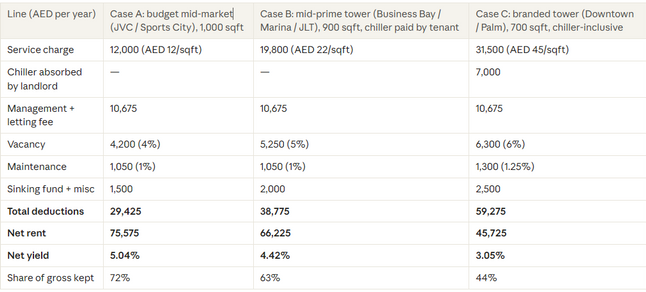
Assume three apartments each producing 7.0% gross yield on a AED 1.5 million purchase, annual rent AED 105,000 in every case. Only the building differs.
Same headline yield. Three genuinely different investments. Case A keeps 72% of gross rent and only just clears our 5% threshold; Case C keeps 44% and nets about 3%. This is the calculation that decides whether Dubai property pays, and it is not what any brochure will show you.
Buying to net: how to actually shop
Every serious purchase decision starts with the RERA Service Charge Index — pull the actual current rate for the specific tower on the DLD REST app, not the community average.
Then ask for the last three years of service charge statements from the seller or the owners' association: consistent year-on-year rises above 5% are a warning sign that the operating cost trajectory is worse than the current headline. Confirm the chiller arrangement in writing (district cooling? central chiller in service charge? individual DEWA?), because it is impossible to model net yield accurately without that answer.
Ask whether recent special assessments have been levied; a well-run building with a healthy sinking fund is worth a slightly higher regular charge over a building that will surprise you with a lift replacement in three years. And in mixed-use buildings, understand what the retail podium contributes to shared costs; it can materially reduce apartment-owner burden.
Two shortcuts we use on the desk.
First, plot service charge against gross yield in the district you're shopping and look for outliers. A building running 60% higher service charges than similar stock for a marginal amenity premium is not the deal it appears.
Second, ignore the first-year gross yield entirely and model year three: by then the honeymoon rental (developers sometimes underwrite the first tenancy) has ended, the service charge has been budgeted realistically, and you are looking at the steady-state yield you will actually earn for the life of the hold.
Why our shortlist has a 5% net threshold
Our internal net yield threshold for shortlist inclusion is 5.0%. It is a threshold, not a target. Meeting it doesn't put a project on the list; only failing it puts a project off it. That number reflects what we think an overseas investor should demand in exchange for accepting the currency position, the operational distance, and the market's specific risks.
It is deliberately not aggressive; it is what a mid-market apartment run properly should clear. When a memo notes that a project "models at 4.1% net against our 5% threshold," the criterion is the point, not a judgement on the developer's product. Some readers reasonably want to buy anyway for currency, capital preservation, or Golden Visa reasons; the memo will still tell you that.
Villas and villa-scale townhouses in mature communities can produce genuinely higher net yields than apartments because the service-charge-per-foot maths cut sharply differently, though the entry ticket is larger and the tenant pool is different. If yield is your primary driver, they are worth a look; the areas page covers where that trade currently stacks up.
Frequently Asked
Are Dubai's 6–8% gross yields real, or marketing?
The gross yields are real and verifiable through public rental data — they exist because Dubai property prices are lower per square foot than most developed markets while rents are supported by a growing population and short-term rental demand. What isn't real is the assumption that gross yield is what you'll earn. Model net.
How do I find the actual service charge for a specific building?
Every registered rate sits on the DLD Service Charge Index, accessible free through the Dubai REST app on your phone. Search by community and building name. If a rate looks materially different from the community's other buildings, that is a signal to ask why before buying.
Should I buy a chiller-inclusive unit or a chiller-paid unit?
Neither is universally better. Chiller-inclusive units command higher rent (roughly the value of the chiller cost) and give you predictable annual outgoings; chiller-paid units are cheaper to rent, easier to lease in some tenant segments, and shift the cooling cost — and its volatility — to the tenant. Model both against comparable listings in the same building and pick the one that produces the higher net after realistic assumptions.
Do I need a property manager if I visit Dubai often?
For a single unit, yes — even if you visit. Distance from Dubai, tenant scheduling, maintenance emergencies, DEWA and chiller account handovers, RERA compliance, and lease drafting are hard to run from Singapore, Kuala Lumpur, or Jakarta at a normal cost of your time. A 6% management fee that returns 20 hours of your year to your career is a straightforward trade.
Do service charges rise over time?
Yes, usually — modestly, and RERA's audit process resists sharp increases. But older buildings with under-reserved sinking funds can see step-ups when major capital works fall due. Ask about the fund and the last five years of budgets before you buy.
What's a "good" net yield in Dubai for an investor from Asia?
5% net is the number we use as a threshold and think an overseas investor should demand. 5–6% net is achievable in the right mid-market building or villa; 4–5% is common in established towers; below 4% typically indicates a lifestyle purchase where yield is not the primary point. Any of those can be a good buy for the right investor — knowing which one you're looking at is what matters.
Service charge ranges, property management fees and chiller cost figures verified 3rd August 2026 against the DLD Service Charge Index, Betterhomes and Property Finder 2026 industry data, and current Empower/Tabreed tariff schedules. Ranges are indicative; always pull the specific building's current registered rate before committing. This page is research, not financial, tax or investment advice. InvestInDubai.Asia is operated by Straits Properties LLC (RERA Licence No. 60340), a licensed Dubai real estate brokerage. We earn commission (typically paid by the developer) when you buy through us. That conflict is disclosed here and on every memo, and our ratings are the application of published criteria to public facts.