Research | Money & Tax | Malaysia
Stamp Duty, RPGT and the Ringgit: The Malaysian Comparison
Verified: 21 July 2026 Last Updated: 21 July 2026 Author: Straits Properties LLC
The Short Answer
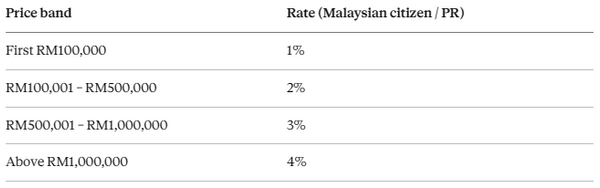
For a Malaysian citizen or PR, the case for Dubai is not entry cost. Buying at home is genuinely cheap for you — 1% to 4% tiered stamp duty for residents versus Dubai's 4% transfer fee.
The comparison shifts once you look further along the trade: RPGT taxes your gain on exit at up to 30% (falling to 0% from the sixth year of ownership), Dubai charges nothing on gain or on rental income, and a Dubai property is a USD-pegged asset held against your ringgit exposure.
If you are a foreign buyer of Malaysian property, the picture inverts — Budget 2026 raised your entry duty to a flat 8%, foreign RPGT is 30% for five years then 10% permanently, and Dubai's 4% flat starts looking straightforward.
Most Dubai marketing to Malaysians reuses the Singapore pitch about entry tax. It does not translate. Malaysian citizens buying at home pay 1–4%, not 20% or 60%, so any "Dubai is cheaper to enter" argument aimed at a Malaysian resident is either uninformed or dishonest. The real Malaysian case for Dubai lives at the exit, in the currency, and in a fundamentally different ongoing tax regime — and for foreign holders of Malaysian property, it also lives at entry, because that cost has changed.
What Malaysia charges you to buy
Stamp duty on Memorandum of Transfer (MOT) is tiered by price, and the schedule has been stable through Budget 2026 for local buyers:
For foreign individuals and foreign-owned companies buying Malaysian property, Budget 2026 introduced a flat 8% stamp duty effective 1 January 2026 — a doubling of the previous 4% rate that materially changes the math for offshore capital comparing markets. Foreign buyers also face state-level minimum purchase price thresholds (commonly RM1 million or higher, varying by state) and state consent requirements that add time and legal fees.
Around the duty sit legal fees, loan stamping, and disbursements — modest by regional standards for locals, higher for foreign purchasers who need state consent. The complete itemized list is on our fees page.
What Malaysia charges you to sell — the RPGT problem
Real Property Gains Tax is where Malaysia and Dubai part company. RPGT is charged on your gain — sale price minus acquisition and allowable costs — at rates that depend on how long you held and on your buyer category. The rates in effect for 2026, unchanged since the January 2022 revision:
Two features to notice. First, a Malaysian citizen who holds beyond year six pays zero RPGT — a genuinely favourable exit regime by international standards, and one of the reasons buying at home has been rational for a generation of Malaysian investors. Second, a foreign holder of Malaysian property never reaches zero: 30% for five years, 10% permanently thereafter. That floor is a compounding cost every foreign investor in Malaysian property should be modeling explicitly.
For the citizen holding for 6+ years, RPGT effectively does not apply. For the citizen selling earlier — because life happens, or a better deployment appears, or a specific investment thesis has played out — a 15–30% tax on gain against Dubai's 0% is a large gap. It is why "buy at home cheap, sell at home taxed" is the honest framing of the Malaysian case, and why any comparison that stops at entry cost is telling you half the story.
What Dubai charges you
Flat 4% Dubai Land Department transfer fee at purchase — every buyer, every profile, first property or fifth. A small registration admin fee, agency commission on secondary purchases (developer-paid on most off-plan), and 0.25% mortgage registration if you finance. All-in acquisition costs typically land around 4–5% on a cash off-plan purchase.
Then nothing ongoing: no annual property tax, no tax on rental income for individual owners, no capital gains tax on sale, and no holding-period tax equivalent to RPGT. The UAE's corporate tax regime does not apply to individuals holding personal property investments.
The two comparisons, side by side
Malaysian citizen or PR — buying at home vs Dubai:
Read that as: entry is roughly a wash to slightly cheaper at home; ongoing and exit taxes favour Dubai heavily unless you hold Malaysian property past year six. That is why the Malaysian case for Dubai is a holding-period-and-exit case rather than an entry-cost case.
Foreign buyer — Malaysian property vs Dubai property:
Same table, different reading. For an offshore investor comparing markets, Malaysian property post-Budget-2026 is materially more expensive to enter than Dubai, taxes rental income where Dubai does not, and carries a permanent 10% RPGT floor at exit. The case for Malaysia over Dubai for foreign capital now rests on other things — familiarity, use as a secondary residence, MM2H considerations — rather than on the tax structure.
Worked examples: RM1.5M, held for the different windows
Assume a straightforward capital gain of RM300,000 over the holding period. Cost basis of RM1.5M plus modest incidentals, no renovation deductions.
Malaysian citizen selling at year 3: MOT at entry approximately RM44,000; RPGT on a gain of RM300,000 at 30% (after the automatic RM10,000 / 10%-of-gain exemption) ≈ RM81,000. Total tax through the trade: about RM125,000 on a RM1.5M asset.
Malaysian citizen selling at year 6+: Same MOT at entry; RPGT zero. Total tax through the trade: about RM44,000. This is genuinely favourable, and is why long-hold Malaysian residential remains a rational core position for locals.
Same RM300,000 gain on a Dubai property, held any period, sold by an individual owner: 4% DLD fee at entry — approximately the equivalent of RM60,000 on RM1.5M; no ongoing tax; no exit tax. Total tax through the trade: about RM60,000, independent of holding period.
Foreign buyer purchasing RM1.5M of Malaysian property after 1 January 2026: 8% flat MOT ≈ RM120,000 at entry; 30% RPGT if selling within five years, 10% if beyond — so between RM27,000 and RM81,000 on the RM300,000 gain. Total tax through the trade: at least RM147,000 in the best case, and materially more if you sell early.
A calculator with Malaysian and Singaporean modes is coming; until then we'll run your numbers in a 30-minute review.
The ringgit against a USD-pegged asset
The dirham has been pegged to the US dollar at 3.6725 since 1997. The ringgit is not. Over the last decade, the ringgit has moved meaningfully against the dollar, and by extension against the dirham — sometimes both ways in the same year. Buying a Dubai property from Malaysia therefore means, whether you frame it that way or not, taking a long-USD position against MYR for the life of the holding. If you already believe you are ringgit-heavy — most Malaysian investors are, in career, business, and property — a Dubai purchase is one of the more direct ways to add hard-currency exposure to your balance sheet, without the reporting complexity of holding US securities.
That is a position, not a certainty. The peg page explains how the peg is sustained, what it would take to move it, and how to think about the exposure honestly rather than as a marketing point. It is a case for Dubai for many Malaysian investors, and a reason for others to hold more of what they already own at home.
What this comparison doesn't capture
Three things any honest Malaysian assessment has to acknowledge. First, Malaysian residential in your home state is deeply liquid, well-understood, and financeable at rates that will be hard to match in Dubai — you have a home-field advantage on Malaysian property that no research page can replicate for you. Second, Dubai gross yields are higher than most KL or Penang residential yields, but the honest comparison is gross-to-net, and Dubai service charges are materially heavier than Malaysian condo maintenance fees — model net or expect disappointment. Third, MM2H holders, longer-stay foreign residents, and Malaysian dual-property households each have their own tax and residency wrinkles that a general page cannot cover; those cases are where a conversation earns its keep.
For the Malaysian citizen already holding several years of a Malaysian property with a large latent gain, the honest advice sometimes is: hold it to year six for the 0% RPGT, and deploy new capital to Dubai rather than trading out of your Malaysian position. RPGT is not something to be paid; it is something to be waited out.


Frequently Asked
As a Malaysian citizen, will I pay Malaysian tax on my Dubai rental income?
Malaysian-source rental income is generally taxable in Malaysia. Foreign-source rental income received in Malaysia has historically been exempt in most cases for individuals, subject to conditions that have evolved in recent years.
Does owning a Dubai property affect my ability to claim the once-in-a-lifetime private residence exemption in Malaysia?
No. The Malaysian private residence exemption applies to the disposal of a Malaysian residence and is independent of overseas property holdings. Confirm the current conditions on LHDN Form CKHT 3 with your tax adviser.
How is RPGT collected? Do I actually write a cheque?
The buyer's lawyer withholds 3% of the disposal price (7% for foreign sellers) and remits it to LHDN within 60 days of disposal. Your final RPGT is assessed against that withholding — a shortfall is topped up, an overpayment is refunded.
I bought at RM1.5M and the sale is only breakeven. Do I still pay RPGT?
No. RPGT is charged on the chargeable gain, not the sale price. If there is no gain, there is no RPGT — but you still file the CKHT return. Renovation costs, legal fees at purchase, and agent commission at sale can reduce a gain; keep every receipt.
Is the ringgit really that unstable against the dirham?
The dirham is fixed to the dollar; the ringgit is not fixed to anything. Whether MYR has been stable, weak or strong against the USD in any given period depends on the period. The point is not to forecast it — it is to notice that a Dubai property is a currency position, and that Malaysian investors are generally already overweight ringgit through everything else they own.
As a foreigner buying in Malaysia, does the 8% stamp duty apply to residential only?
The Budget 2026 changes apply to acquisitions by foreign individuals and foreign-owned companies of Malaysian property; specific applicability by property type and structure should be confirmed with a Malaysian conveyancing solicitor before you commit — the number is high enough to matter.
Malaysian MOT stamp duty and RPGT rates verified against LHDN and Real Property Gains Tax Act 1976 published schedules. Foreign buyer 8% stamp duty per Budget 2026 changes effective 1 January 2026. Dubai fees verified against DLD published schedules. This page is research, not financial, tax or investment advice. InvestInDubai.Asia is operated by Straits Properties LLC (RERA Licence No. 60340), a licensed Dubai real estate brokerage. We earn commission (typically paid by the developer) when you buy through us. That conflict is disclosed here and on every memo, and our ratings are the application of published criteria to public facts.